Shenzhen Wandanan Precision Technology Co., Ltd Info@szwandaancnc.com


Views: 0 Author: Site Editor Publish Time: 2026-04-22 Origin: Site


Battery Energy Storage Systems (BESS) require more than just basic enclosures to function effectively. The physical cabinet acts as the frontline defense against thermal runaway, severe environmental degradation, and strict regulatory compliance failures. As global energy demands scale, harsh manufacturing realities set in. Scaling energy storage requires precision Sheet Metal Fabrication to balance structural integrity, active thermal management, and robust production efficiency. Standard metal boxes simply cannot manage the dynamic loads of modern lithium-ion arrays.
This guide helps you evaluate, specify, and source reliable sheet metal cabinets for power storage – including material selection, safety compliance, and design tips for long-term reliability. You will discover a definitive framework for evaluating, specifying, and sourcing a reliable Sheet Metal Cabinet for Power Storage. You will learn how to optimize material selection, navigate complex safety compliance, and future-proof your designs without compromising on system safety or expected lifespan.
A custom sheet metal cabinet for power storage must integrate payload support, HVAC routing, and fire suppression systems directly into its architecture.
Material selection (Aluminum vs. Carbon Steel vs. Stainless Steel) dictates NEMA/IP ratings and long-term corrosion resistance.
Advanced sheet metal fabrication mitigates implementation risks through modular design, such as 3D-adjustable internal racks for evolving battery dimensions.
Evaluating a manufacturing partner requires verifying end-to-end capabilities (DFM, UL 50 compliance, and single-source assembly) to prevent supply chain bottlenecks.
Standard off-the-shelf racks often fail in dynamic BESS environments. These generic structures lack the rigidity necessary for heavy industrial use. A specialized enclosure must physically house and protect several sensitive components. It holds heavy battery modules, the Battery Management System (BMS), PCS inverters, and HVAC cooling systems. Every component relies on the cabinet for physical security and environmental isolation.
Engineers face a constant battle between structural rigidity and maintenance access. Lithium-ion arrays carry immense physical weight. Structural frames must manage this dense payload without bowing or warping over time. However, securing this weight cannot prevent routine maintenance. You must design for human factors.
Controlling lift-door weight represents a common engineering challenge. Thick doors offer great security but create hazardous maintenance conditions. We recommend keeping upper operable panels between 1.2mm and 2mm thick. This specific thickness avoids premature hinge failure while maintaining adequate security against vandalism. Technicians need safe, reliable access points to perform emergency servicing without lifting excessively heavy metal sheets.
You must choose how to integrate physical systems. The industry typically uses three primary enclosure architectures. Each method serves different deployment scales and site requirements.
Discrete Cabinets: These separate the battery modules from the inverters and cooling systems. They offer excellent flexibility for constrained outdoor spaces.
Rack-Type Modular Enclosures: These systems allow you to slide components into standardized slots. They excel in indoor utility rooms requiring rapid capacity expansion.
Integrated Base-Mounted Systems: Also known as all-in-one units. They consolidate the entire BESS into one large footprint. They simplify site installation but complicate internal fault diagnosis.
Architecture Type | Primary Advantage | Ideal Deployment Scenario | Maintenance Consideration |
|---|---|---|---|
Discrete Cabinets | High placement flexibility | Irregular outdoor utility spaces | Requires external cable routing checks |
Rack-Type Modular | Rapid scalability | Indoor server or power rooms | Easy module swapping via sliding trays |
Base-Mounted All-in-One | Streamlined installation | Large-scale grid storage farms | Difficult access to deep internal faults |
Choosing the right metal dictates the entire lifecycle of your enclosure. We assess materials based on three critical criteria: strength-to-weight ratio, thermal conductivity, and environmental resilience. Wrong material choices lead to rapid rust, overheating, or structural collapse.
Stainless steel remains the premium standard for harsh, corrosive environments. It offers exceptionally high tensile strength and longevity. Grade 316L adds molybdenum, providing superior resistance against coastal salt spray. While it delivers ultimate durability, it comes at a premium cost. You should reserve stainless steel for severe marine or heavy industrial applications where failure is catastrophic.
Carbon steel provides a highly cost-effective and structurally dense alternative. It forms the backbone of most budget-conscious grid projects. However, carbon steel rusts rapidly if left untreated. It requires a robust, multi-stage surface treatment protocol. Manufacturers must apply rigorous degreasing, thorough zinc-plating, and a heavy powder coating. When treated correctly, carbon steel delivers incredible impact resistance for landlocked, temperate environments.
Aluminum stands out as the preferred choice for outdoor modular systems. It boasts an exceptionally high strength-to-weight ratio, making transportation and site installation much easier. Furthermore, aluminum provides natural RFI/EMI electromagnetic shielding. It protects sensitive BMS electronics from external interference. Aluminum also offers superior passive thermal dissipation. It pulls heat away from internal battery cells faster than steel counterparts.
Material thickness directly impacts safety and manufacturing viability. We heavily recommend using heavy-duty materials for structural frames. Utilizing 12 GA steel (approximately 2.6mm) prevents dangerous frame warping under heavy battery loads.
However, you must avoid over-engineering the enclosure. Many designers mistakenly specify overly thick plates to increase perceived strength. Overall plate thickness exceeding 6mm often complicates assembly. Thick plates resist precise bending and cause severe distortion during welding. Stick to the 2.6mm range for structural integrity, and use thinner 1.2-2mm sheets for accessible paneling.
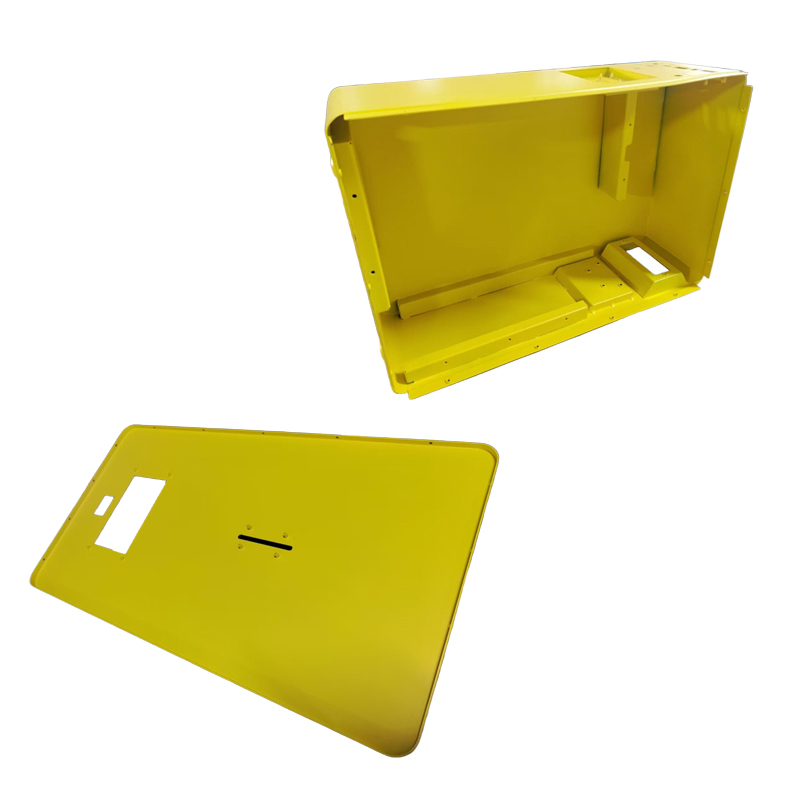
The physical shell must actively support system safety. Relying on "dumb" metal boxes inevitably leads to thermal pooling. Trapped heat degrades battery chemistry and triggers hazardous thermal runaway events. Smart enclosure engineering blends structural design with active hazard mitigation.
Water intrusion destroys high-voltage systems. Choosing the correct welding and sealing method guarantees watertight integrity across the cabinet lifecycle.
We often compare two primary welding techniques for battery enclosures:
CO2 Gas-Shielded Welding: This method produces full, continuous welds. It delivers unmatched structural strength and absolute watertight integrity. We use it heavily on thick carbon steel load-bearing frames.
Fiber Laser Welding: This technique concentrates heat into a highly focused beam. It significantly reduces thermal deformation on thinner plates. We deploy laser welding on aluminum exterior panels and operable doors where aesthetic precision matters.
Beyond welding, insulation plays a critical role. Industrial-grade gaskets prevent moisture ingress around door seams. Implementing closed-cell polymer insulation and mineral wool lining helps stabilize internal temperatures. These materials prevent exterior solar radiation from baking the sensitive lithium-ion cells inside.
Modern fabrication must seamlessly house emergency systems. Your design must accommodate fire suppression routing, explosion-proof venting, and thermal sensors directly within the metalwork. Pre-cutting these integration points during the laser-cutting phase ensures precise fitment later.
Meeting standard testing benchmarks proves your system's reliability. A properly engineered cabinet should target specific compliance ratings:
NEMA 3R: Essential for general outdoor weather protection against rain and ice.
NEMA 4X: Required for severe washdown environments or coastal deployments facing salt corrosion.
IP54/IP65: International standards ensuring dust and water jet resistance.
UN38.3: Certifies transport stability, ensuring the fully loaded cabinet survives harsh transit vibrations without structural failure.
Deployment risks multiply when hardware cannot adapt. Battery technology evolves much faster than physical infrastructure. Hard-tooling a cabinet for one specific battery dimension creates rapid obsolescence. When manufacturers release new, denser battery cells next year, a rigid cabinet design becomes useless.
You can mitigate obsolescence through modular architecture. Precision fabrication allows us to create 3D adjustable internal brackets. These sliding, modular racks expand or contract horizontally and vertically. They easily fit next-generation cells without requiring a complete cabinet redesign. This approach saves significant capital over a twenty-year project lifecycle. It allows utility operators to upgrade battery chemistries while reusing the original heavy-duty exterior shell.
An outdoor cabinet must survive UV radiation, acid rain, and physical abrasion. Ensuring a 20+ year lifecycle requires strict surface treatment protocols. Skipping pre-treatment phases guarantees premature paint peeling and rust.
The metal must undergo thorough neutralization and passivation before painting. These chemical baths strip away invisible oils and prepare the metal surface at a microscopic level. Only then should manufacturers apply industry-standard finishes, like the highly durable ANSI #61 gray powder coating. This specific baked-on finish guarantees exceptional UV resistance. It reflects sunlight efficiently, aiding the cabinet's passive thermal management strategy.
Sourcing a manufacturer dictates the success or failure of your energy storage project. Fragmented supply chains introduce severe tolerance stack-ups. Using separate vendors for laser cutting, welding, powder coating, and final assembly destroys quality control. It also guarantees project delays when parts do not fit together.
You need a consolidated approach. To evaluate a Sheet Metal Fabrication partner effectively, you must verify their end-to-end capabilities.
DFM (Design for Manufacturing) Engineering: Before cutting metal, your partner must optimize your CAD file. A strong DFM review reduces material scrap, eliminates unnecessary welding time, and identifies structural weak points.
Single-Source Vertical Integration: Keep production under one roof. Your partner should perform turret punching, fiber laser cutting, PEM hardware insertion, and sub-assembly in the same facility. This eliminates shipping delays between sub-contractors and maintains strict tolerance control.
Certifications: Never accept unverified claims. Look for baseline quality trust signals like the ISO 9001:2015 certification. Furthermore, request their regulatory compliance files. Holding UL 50 certifications for industrial control enclosures proves they understand rigorous electrical safety standards.
A properly engineered sheet metal cabinet for power storage serves as a critical risk-mitigation asset. It is never merely a commodity expense. The right enclosure protects volatile battery chemistries from severe weather, prevents thermal pooling, and guarantees regulatory compliance. By selecting the correct materials—whether lightweight aluminum or dense carbon steel—long-term structural integrity is ensured.
For engineers and project managers looking for a fabrication partner with over 20 years of experience in sheet metal enclosures, Shenzhen Wanda-An Precision Technology Co., Ltd. is worth considering. The company has supplied custom cabinets for energy storage, telecom, and industrial applications, and welcomes inquiries on new projects.
A: Structural load-bearing frames perform best using 12 GA steel (approximately 2.6mm). This prevents frame warping under heavy battery loads. However, upper operable doors should remain between 1.2mm and 2mm. This balance prevents hinge failure and ensures technicians can safely open the cabinet during routine maintenance.
A: Compliance relies on strict moisture and dust exclusion. Manufacturers achieve this through continuous gas-shielded welding, eliminating microscopic seam gaps. Strategic fold designs channel rainwater away from critical door gaps. Finally, integrating automotive-grade rubber sealing gaskets blocks wind-driven rain and corrosive salt spray.
A: Yes. Precision fabrication integrates safety systems natively. During the laser-cutting phase, manufacturers pre-cut exact integration points for HVAC routing, explosion-proof venting, and fire suppression nozzles. This eliminates the need for dangerous on-site modifications and ensures emergency systems deploy perfectly during thermal events.
A: Aluminum offers a remarkable strength-to-weight ratio, simplifying transportation and site installation. It provides excellent natural RFI/EMI electromagnetic shielding, protecting sensitive battery management electronics. Additionally, aluminum delivers superior passive thermal dissipation, drawing damaging heat away from the cells much faster than standard steel options.


