Shenzhen Wandanan Precision Technology Co., Ltd Info@szwandaancnc.com


 |


| Quantity: | |
|---|---|
Custom Threaded Copper Busbar
Threaded copper busbars play a vital role in modern electrical systems where reliability, compact design, and ease of assembly matter most. Their integrated threads simplify connections, reduce hardware parts, and support high-current applications in demanding environments.
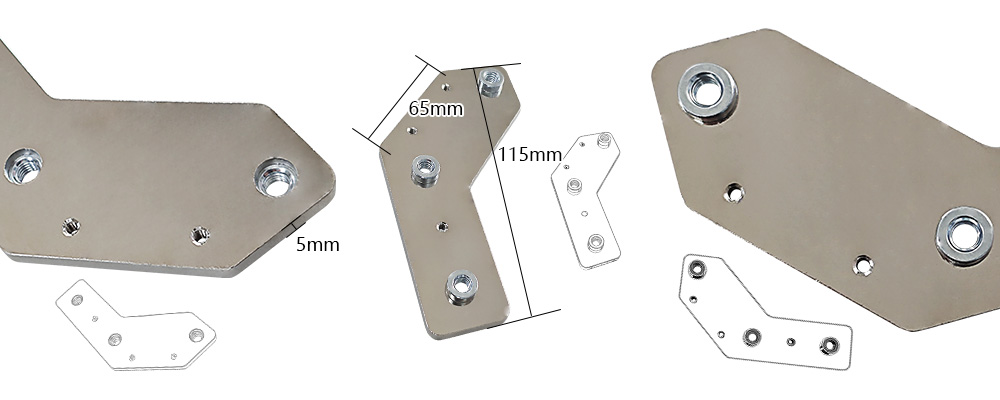
Applications of threaded copper busbar:
Threaded copper busbars are widely used across industries where secure, maintenance-friendly electrical connections are essential.
·Power Distribution & Switchgear - In low-voltage and medium-voltage switchgear, threaded busbars enable fast bolt-on connections for circuit breakers, relays, and cable terminations. Their high conductivity and stable contact resistance make them ideal for continuous current ratings often reaching hundreds of amps.
·Renewable Energy & Energy Storage - Solar inverters, battery management systems, and power conversion equipment rely on threaded busbars to link battery modules, fuses, and DC disconnects. The threads accommodate lug terminals and laminated flexible connectors without additional drilling.
·Electric Vehicle & Charging Infrastructure - Onboard chargers, power distribution units (PDUs), and off-board DC fast chargers use compact threaded copper busbars to route high currents between modules. They reduce assembly time and improve thermal performance under pulse loads.
·Industrial Automation & Drives - In motor control centers, variable frequency drives, and robotic welding cells, threaded busbars simplify internal power distribution and ensure vibration-resistant connections when combined with spring washers or locking fasteners.
·Data Centers & Telecom - Busbar trunking systems and backup power racks frequently employ threaded copper bars to create modular, reconfigurable power tap-offs. The threaded points allow hot-swappable connections without shutting down critical loads.
Precautions & Design Considerations:
When selecting and installing threaded copper busbars, several factors must be evaluated to ensure safety, longevity, and optimal performance.
1. Thread Type & Strength - The choice between tapped threads (internal threads directly in the copper bar) and press-fit threaded inserts matters. Copper is relatively soft; for frequent assembly/disassembly, stainless steel or brass inserts are often preferred to prevent thread stripping. Always verify pull-out strength and torque ratings based on the insert design and wall thickness.
2. Surface Plating - Bare copper oxidizes quickly, increasing contact resistance. Tin plating offers corrosion protection and maintains low resistance while being cost-effective. For harsh environments or high-temperature applications, silver or nickel plating may be required. Ensure the plating process does not clog or compromise the threads.
3. Creepage & Clearance - The position of threaded studs or inserts must respect voltage-dependent creepage and clearance requirements. This is especially critical in high-voltagesystems where threads protruding from an insulation layer could create tracking paths. Proper insulation design, sleeving, or shrouding around each threaded point is essential.
4. Thermal Expansion & Joint Relaxation - Copper expands as temperature rises. Threaded connections may loosen over thermal cycles if not properly torqued or if unsuitable fasteners are used. Use Belleville washers, coned disc springs, or thread-locking compounds (where appropriate) to maintain constant pressure. Periodic re-torquing during maintenance is also recommended.
5. Galvanic Corrosion - When aluminum conductors or busbars are bolted to threaded copper pads, galvanic corrosion can occur in the presence of moisture. Use bi-metalliccontact plates, jointing compounds, or appropriate plating (e.g., tin on both surfaces) to minimize corrosion at the bolted interface.
6. Current Density & Hot Spots - Avoid locating threads in areas with excessively high current density, as the thread roots can concentrate current flow and create local hotspots. Finite element analysis (FEA) may be employed to optimize thread placement relative to the busbar cross-section.
7. Busbar Bending & Forming - If the busbar must be bent or formed before threading, ensure the threaded zone remains flat and distortion-free. Bending near a tapped hole can deform threads, making bolt insertion difficult. Custom manufacturing should sequence forming and tapping carefully.
At Wanda An, we offer customized manufacturing based on customer drawings
Most threaded copper busbars are not off-the-shelf components. They are fabricated to exact customer specifications through a collaborative engineering process.
·Drawing Review & DFM Feedback - The manufacturing partner reviews the client's 2Dor 3D drawings (commonly in DWG, DXF, STEP, or PDF formats) and provides Design for Manufacturability suggestions. This includes feedback on thread depth versus material thickness, minimum edge distance for tapped holes, corner radii to avoid stress concentrations, and plating masking requirements.
·Material Selection & Preparation - Busbars are typically cut from high-conductivity copper sheets or extruded bars, such as C11000 or C10100, where higher conductivity or vacuum compatibility is required. The raw material is sawed, laser cut, punched, or waterjet cut depending on shape complexity and volume.
·Forming, Bending & Machining - Custom busbars often require multi-step bending(90°, U-bends, complex angles) using CNC press brakes or dedicated tooling. Critical threaded features are machined using CNC milling centers or drilling and tapping machines. For high-volume production, thread rolling may be used to strengthen the thread area. Tight tolerances (+0.1 mm or better) are held on center distances and flatness to guarantee alignment with mating components.
·Insulation Application - Many threaded busbars are partially insulated using epoxy powder coating (flocking), PVC heat shrink, or liquid silicone rubber injection. Masking before coating leaves threaded studs or contact areas clean and conductive. In complex designs, snap-on or glued insulation covers are also used.
·Plating & Surface Treatment - After machining and forming, busbars are cleaned, degreased, and plated to spec. Electrolytic tin plating (matte or bright) to 5-15 um thickness is common. For threads, special care is taken to avoid excessive buildup that could alter fit tolerances. For threaded inserts, plating is often applied before insertion to prevent hydrogen embrittlement or chemical damage to the insert material.
If you require custom copper busbars - whether threaded, fabricated, bent, plated, or fully insulated - our engineering team is ready to assist. Simply share your design or technical sketch with us, and we'll return a detailed proposal with a free quotation tailored to your volume and specification. Get in touch today, and let's turn your design into a production-ready solution.


