Shenzhen Wandaan Precision Technology Co., Ltd Info@szwandaancnc.com

- All
- Product Name
- Product Keyword
- Product Model
- Product Summary
- Product Description
- Multi Field Search
Please Choose Your Language


 |


| Quantity: | |
|---|---|
Custom Bent Copper Busbar
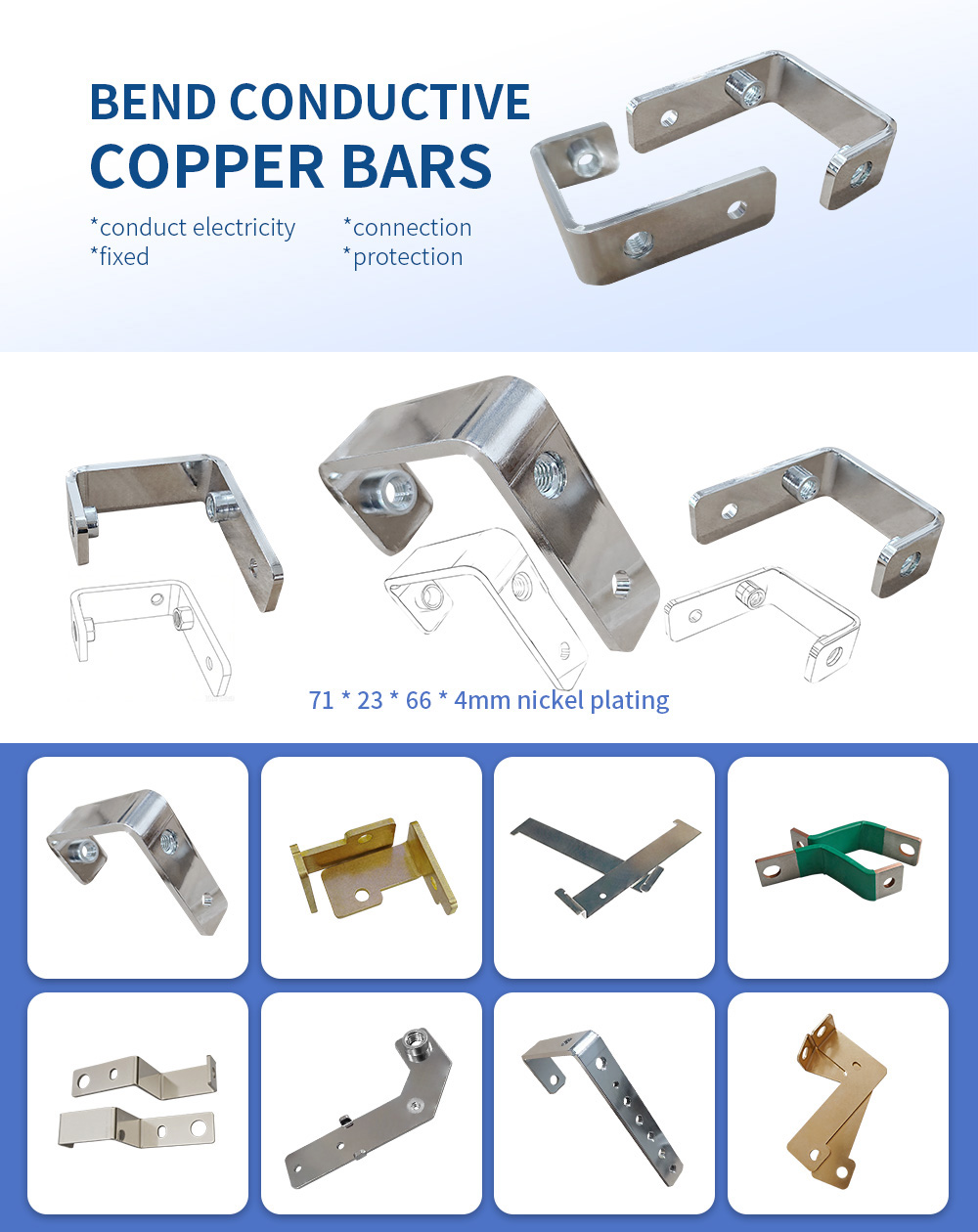
Bent copper busbar is a pre-formed conductor made of high-purity copper, shaped through precision bending to fit specific geometries within electrical distribution systems. Unlike straight bars, bent busbars are designed to navigate around obstacles, connect components at different heights or angles, and optimize layout in compact enclosures. They serve the same fundamental role as any busbar-to distribute power from a source to multiple outgoing circuits- while eliminating the need for multiple cable runs and reducing assembly complexity.
2. Applications Across Industries
Bent copper busbars are essential where space, reliability, and high current capacity meet. Copper busbars produced by Wanda An are applied in various industries; key industries include:
· Switchgear and Control Panels: for connecting circuit breakers, disconnect switches, and meters in low-voltage and medium-voltage assemblies.
· UPS Systems and Data Centers: compact, bent busbars enable high-density power distribution inside uninterruptible power supplies and server racks.
· New Energy Vehicles: battery packs for electric vehicles and hybrid systems use custom-bent busbars to interconnect cells or modules, ensuring safe, high-current transmission.
· Energy Storage Systems: large-scale battery storage and renewable integration rely on bent copper busbars for efficient, low-resistance connections.
· Photovoltaic Inverters: bent configurations simplify internal wiring between DC inputs and AC outputs.
· Industrial Power Distribution: machinery, motor control centers, and test equipment benefit from bent busbars that reduce wiring errors and speed up installation.
3. Material Selection Criteria
The performance of a bent busbar depends heavily on the base material and surface treatment.
Copper Grade
High-conductivity copper such as T2 (C11000, Cu-ETP) with a minimum purity of 99.9% is the standard. It offers an electrical conductivity of > 100% IACS, ensuring minimal resistive losses and low heat generation. Oxygen-free copper (TU1) is chosen for critical applications demanding the highest purity and resistance to hydrogen embrittlement.
Why Copper over Aluminium
· Lower resistivity: allows more compact designs with higher current density.
· Superior thermal conductivity: dissipates heat more effectively, keeping temperature rise within safe limits (typically below 65°C rise over ambient).
· Lower thermal expansion: reduces mechanical stress on joints and supports.
· Higher mechanical strength: withstands clamping forces and vibration without deformation.
Surface Finishes
To combat oxidation and ensure long-term reliability, bent busbars are often plated or coated:
· Bare copper: used in controlled indoor environments.
· Tin plating: most common; provides corrosion resistance and excellent solderability.
· Nickel or silver plating: for high-temperature or low-contact-resistance applications.
· Insulation: Polyolefin heat-shrink tubing, PVC dip coating, or epoxy powder coating are applied where live parts must be protected.
4. Bending and Fabrication
At Wanda-An, copper busbars are produced using CNC bending machines that guarantee repeatability and accuracy. Input from digital engineering tools allows direct transfer of bending programs, minimizing manual errors. The process can include punching, drilling, tapping, and forming complex shapes. For flexible connections, laminated copper foil busbars can be bent during installation, while rigid solid bars are pre-bent to the final shape.


