Shenzhen Wandanan Precision Technology Co., Ltd Info@szwandaancnc.com


 |


| Quantity: | |
|---|---|
Server Chassis Manufacturer
Server chassis (also referred to as a server case, server enclosure, or server housing) is the physical metal framework or outer shell that houses, protects, and structurally supports the internal hardware components of a server.
More than just a protective box, the server chassis provides the mechanical foundation for organizing and securing critical hardware. It typically incorporates built-in cooling systems such as fans and strategically placed ventilation to maintain safe operating temperatures, drive bays and expansion slots for scalability, and power supply mounting points. In rack-mount configurations, the chassis conforms to standardized heights (1U, 2U, etc.) so that multiple servers can be efficiently stacked inside standard 19-inch server racks or cabinets. In environments like data centers and enterprise IT rooms, the chassis also plays a role in electromagnetic interference (EMI) shielding and streamlined cable management, contributing to overall system stability, reliability, and ease of maintenance.
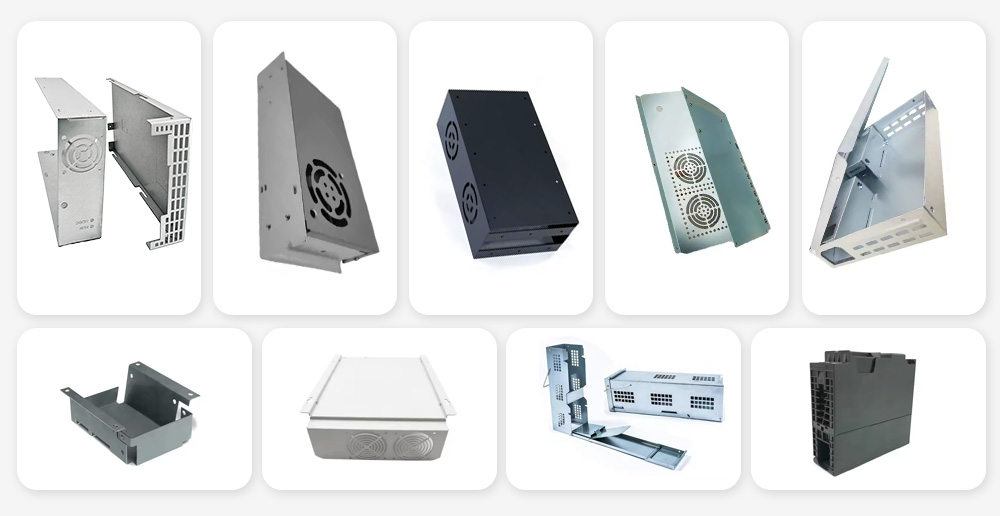
Wall-mount chassis resemble standalone desktop towers. They offer easy component access and generally quieter operation, making them suitable for small offices, branch locations, or departmental use where rack infrastructure is absent. Their main advantage is simplicity and lower initial cost for low-scale operations.
Rack-mount chassis are the backbone of data centers, designed to fit standard 19-inch racks. They come in standardized heights measured in rack units (1U, 2U, 4U, etc.). The compact, stackable form maximizes floorspace and allows high-density deployments. These chassis typically support hot-swappable drives, redundant power supplies, and advanced cooling. They are used for web hosting, cloud computing, enterprise IT infrastructure, and any scenario demanding scalability and efficient remote management.
| Chassis Type | Form Factor | Typical Applications |
| Wall-mount Chassis | Standalone upright enclosure resembling a desktop PC; large internal space for expansion; independent cooling design; typically single or dual processor; low-density deployment. | Small and medium business file storage; development and test environments; enterprise websites; medical imaging; virtual desktop infrastructure (VDI); branch offices. |
| Rack-mount Chassis | Standard 19-inch width; heights of 1U, 2U, 3U, 4U, 6U etc.; stacks efficiently in racks; supports hot-swappable drives and redundant power supplies;remote management; high density andcentralised management | Cloud computing platforms; software-defined storage;hyper-converged infrastructure; CDN caching; supercomputing centres; enterprise IT infrastructure; large-scale data centres |
| Cabinet Chassis | Integrated compute, storage, and networking in a single cabinet; centralised redundant power; unified fan-wallcooling; separation of functional and support modules; simplified maintenance and automated deployment. | Virtualisation platforms; big data analytics; integrated data centre infrastructure; future-oriented core architecture deployments. |


