Shenzhen Wandanan Precision Technology Co., Ltd Info@szwandaancnc.com


 |


| Quantity: | |
|---|---|
Custom Machining Robot Components
Product Description
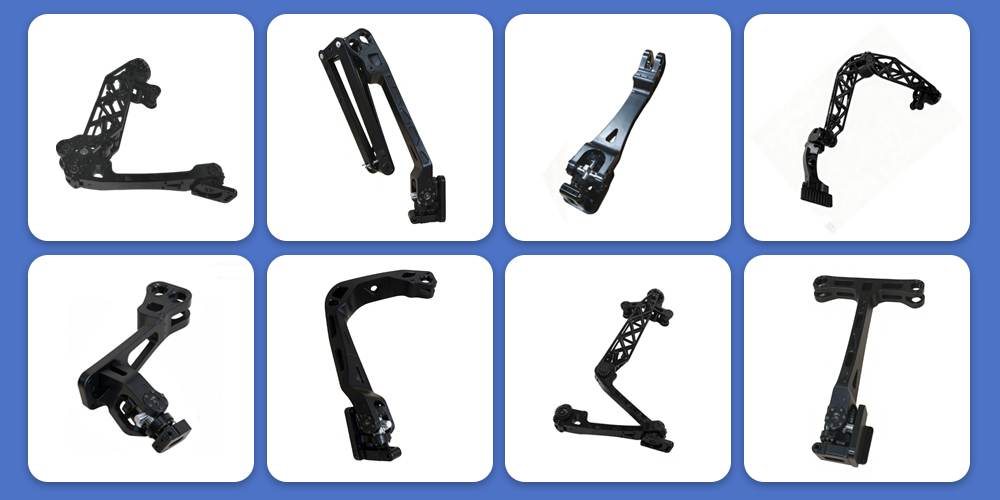
Custom machining robot components are precision-engineered parts designed and manufactured to meet the specific requirements of robotic systems. Unlike off-the-shelf alternatives, these components are built from the ground up to match exact geometries, load conditions, and performance specifications of a particular robot model or application. They serve as the fundamental building blocks that determine how a robot moves, carries payloads, and maintains accuracy over thousands of operating cycles. A well-designed custom-machined robot component integrates multiple functional features into a single piece. An arm link, for instance, is not simply a structural beam. It incorporates precisely machined pockets to reduce weight without sacrificing stiffness, threaded fastener holes positioned to sub-millimeter accuracy for assembly alignment, and internal cable routing channels that protect wiring harnesses from abrasion during continuous motion. Jointhousings must accommodate bearing seats, motor mounts, and gearbox interfaces within a compact envelope, all while maintaining the geometric relationships that ensure smooth rotation and zero backlash.
The value of custom machining lies in its ability to optimize every dimension for function. Standard catalog parts force design compromises. Custom components allow engineers to place material exactly where stress analysis demands it and remove it everywhere else. This results in lighter, stiffer, and more durable robots that consume less energy and achieve higher positioning repeatability. From prototype development through full-scale production, custom-machined components give robotics companies the freedom to innovate without being constrained by what is available on a shelf.
Materials
Material selection for robot components is a balancing act between strength, weight, machinability, and cost. The choice directly affects the robot's payload capacity, speed, power consumption, and service life.
Aluminum alloys dominate the landscape of custom robot components, and for good reason. Aluminum 6061-T6 is the workhorse material, offering an excellent strength-to-weight ratio, good corrosion resistance, and outstanding machinability. It welds reliably, accepts a wide range of surface finishes, and costs significantly less than aerospace-grade alternatives. For components that demand higher strength, 7075-T6 aluminum delivers tensile strength comparable to mild steel at roughly one-third the weight. This makes it ideal for highly stressed arm links, actuator brackets, and structural plates in high-performance robots. The trade-off is reduced corrosion resistance and higher material cost.
Stainless steel enters the picture when the application demands superior wear resistance, corrosion protection, or simply more mass for damping. Grades 304 and 316 stainless steel are common choices for robot components exposed to washdown environments, food processing, or marine conditions. Their higher density can actually be an advantage in applications where added mass helps stabilize the robot or counterbalance payloads. The machining difficulty and cost increase significantly compared to aluminum, but for critical joint components like bearing housings and gear mounts, the durability payoff justifies the investment.
Surface Finish
Surface finish serves both functional and aesthetic purposes in robot components. The right finish protects against corrosion, reduces friction, improves wear resistance, and can even contribute to the robot's visual identity.
Anodizing is the most common surface treatment for aluminum robot components. Type I anodizing creates a durable oxide layer that resists corrosion and provides an excellent base for dye coloring. This allows manufacturers to apply brand colors or use color coding to distinguish different robot models and component types. Type III hard anodizing produces a thicker, harder surface that significantly improves wear resistance, making it suitable for sliding surfaces and components that experience frequent contact or abrasion.
For stainless steel components, passivation is the standard treatment. This chemical process removes free iron from the surface and enhances the natural chromium oxide layer, dramatically improving corrosion resistance without changing the part's appearance or dimensions. Electropolishing goes a step further, creating an ultra-smooth, bright surface that resists bacterial adhesion and is easy to clean, making it ideal for medical and food-grade robots.
Powder coating provides a tough, chip-resistant finish for larger structural components like robot bases and frames. It offers a wide range of colors and textures while providing excellent protection against impacts and environmental exposure. Bead blasting and brushing are mechanical finishing processes that create uniform matte or satin textures. These finishes hide fingerprints and minor scratches well, making them popular for consumer-facing robot components and collaborative robots that interact closely withhumans.
Manufacturing Process
CNC machining is the backbone of custom robot component manufacturing. The process uses computer-controlled cutting tools to remove material from a solid block, producing parts with exceptional accuracy and repeatability. Modern CNC machining centers combine multiple operations in a single setup, reducing handling time and eliminating the cumulative errors that occur when parts are moved between different machines.
Three-axis CNC milling handles the majority of robot component features, including flat surfaces, pockets, slots, and drilled holes. The workpiece is fixed to a moving table while the cutting tool moves in three linear axes. This is sufficient for most arm links, mounting plates, and simple brackets. Four-axis machining adds a rotary axis that allows the workpiece to be rotated, enabling machining on multiple faces without re-fixturing. This is particularly valuable for joint housings and components with features on perpendicular faces.
Five-axis CNC machining represents the state of the art for complex robot components. The additional axes allow the cutting tool to approach the workpiece from any angle, enabling the production of intricate geometries, undercuts, and compound angles in a single setup. This capability is essential for components like gear housings with angled bores, lightweight structural parts with complex internal cavities, and end-effector mounts that require precise angular relationships between mounting surfaces.
CNC turning produces cylindrical components like shafts, pins, bushings, and spacers with high precision and excellent surface finish. Many robot components combine turned and milled features, requiring multi-tasking machines that can perform both operations in sequence without moving the part. Wire EDM provides an alternative for extremely hard materials or features with sharp internal corners that cannot be produced with rotating cutting tools.
Applications of Machining Robot Component
Custom-machined robot components find applications across virtually every industry that uses robotic automation. The specific requirements vary widely, but the underlying need forprecision, reliability, and application-specific optimization remains constant.
Industrial robotics represents the largest market for custom-machined components. Six-axis articulated robots used in automotive assembly, welding, and material handling require armlinks, joint housings, gear mounts, and end-effector adapters that can withstand millions of cycles under heavy loads. Collaborative robots designed to work alongside humans demand lightweight, smooth-surfaced components that minimize inertia and eliminate pinch points.SCARA robots used in high-speed pick-and-place applications need precision-machined arms and joints that maintain accuracy at rapid cycle rates.
| Robot Component | Material | Application |
| Heavy-load Joints | 7075-T6 Aluminum | Humanoid robots, industrial robot arms |
| Light-load Joints | 6061-T6 Aluminum | Collaborative robots, service robots |
| Robot Frame | 7075-T6 Aluminum / 6082-T6 | Main structural body, load-bearing skeleton |
| Chest Cavity Shell | 6061-T6 Aluminum | Thin-walled enclosure with mounting holes |
| Limb Rods | 7075-T6 , 6061-T6 | Bipedal robots, manipulator arms |
| Dexterous Hand Parts | 7075-T6 Aluminum | Fingertips, finger joints, micro-actuator housings |
FAQ
Q: What is the typical lead time for custom-machined robot components?
A: Lead times vary based on complexity, quantity, material availability, and current shop capacity. Simple aluminum components in small quantities can often be delivered within 5 to 8 workdays. More complex parts requiring five-axis machining, multiple setups, or specialized materials may take 2 to 3 weeks.
Q: How do I choose between aluminum and stainless steel for my robot component?
A: The decision comes down to a few key factors. Choose aluminum when weight reduction is critical, when the component is large and material cost matters, or when complex geometries benefit from aluminum's excellent machinability. Choose stainless steel when the component will be exposed to corrosive environments, when high wear resistance is needed, when added mass is beneficial for stability or damping, or when the application requires food-grade or medical-grade materials. If you are unsure, a good machining supplier can review your application requirements and recommend the most cost-effective material that meets your performance needs.
Q: Can custom-machined components be scaled from prototype to production volumes?
A: Yes, and this is one of the major advantages of CNC machining for robotics. The same machining process used for prototype parts can be scaled directly to production quantities without changing tooling or process parameters. This means the parts you receive in production will be functionally identical to the prototypes you tested and validated. For higher volumes, some suppliers offer production optimization services that reduce cost through fixture design, process refinement, and batch scheduling while maintaining the same quality standards.


